


Infrastructure development in the UAE is the foundation of every successful master-planned community. Roads, drainage systems, water networks, sewerage, electrical infrastructure, telecommunications, irrigation, and other essential utilities must be carefully planned, coordinated, and constructed before individual plots are ready for building development.
For large residential, commercial, industrial, and mixed-use communities, effective infrastructure planning helps developers coordinate multiple utility networks, reduce construction conflicts, manage project phases, and prepare plots for vertical construction.
KTC International has been delivering integrated infrastructure development solutions across the UAE since 1996, covering road works, underground utilities, drainage systems, water networks, sewerage, electrical ducting, telecommunications, landscaping, and associated civil engineering works.
This guide explains how infrastructure development works in the UAE, why proper sequencing is essential, the major infrastructure components involved, and what developers should consider when selecting an experienced infrastructure contractor for large-scale developments.
What Does Infrastructure Development Include in the UAE?
Infrastructure development is the process of planning, designing, constructing, testing, and commissioning the essential civil engineering systems required to support a new development. Before buildings can be occupied, communities require reliable transportation networks, underground utility infrastructure, drainage systems, water supply, sewerage, electrical services, telecommunications, irrigation, and public-realm infrastructure.
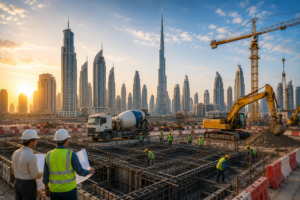
Unlike vertical construction, infrastructure development focuses on the systems beneath and around future buildings. Roads must accommodate traffic movement while providing space for underground utilities, drainage networks must effectively manage stormwater, and utility corridors must be carefully coordinated to avoid conflicts between water pipelines, sewerage systems, electrical ducting, telecommunications cables, and irrigation networks. Each infrastructure component must also comply with applicable local authority requirements while supporting future maintenance and expansion.
Successful infrastructure development requires close collaboration between developers, consultants, contractors, utility providers, and government authorities. Detailed planning during the early stages helps reduce construction delays, minimise costly design changes, and ensure projects progress efficiently from initial site preparation through testing, authority approvals, and final plot handover.
Why Infrastructure Development Is Critical for Master-Planned Communities
Master-planned communities are designed as fully integrated environments that bring together residential neighbourhoods, commercial districts, schools, healthcare facilities, recreational areas, and transportation infrastructure within a single development. The long-term success of these communities depends on reliable, well-coordinated infrastructure that supports daily operations, future growth, and long-term development requirements.
Infrastructure construction establishes the framework on which every future building and community facility depends. Road infrastructure provides access for construction activities, residents, emergency services, and commercial operations, while underground utilities deliver essential services. Drainage systems help manage stormwater, while public infrastructure creates safe and accessible environments for pedestrians and vehicles.
Because these infrastructure systems are interconnected, construction activities must be carefully planned and sequenced. Poor coordination can result in underground utility clashes, repeated excavation, road reinstatement, project delays, and unnecessary construction costs. Integrated infrastructure planning helps developers improve construction efficiency, coordinate utility installations, streamline authority approvals, reduce rework, and prepare individual plots for subsequent building construction.
Complete Infrastructure Development Services We Provide
Every master-planned community depends on multiple infrastructure systems working together as one integrated network. Each system serves a specific purpose, but all components must be planned, installed, tested, and commissioned in the correct sequence to ensure reliable long-term performance.
Road Infrastructure Construction
Road infrastructure forms the backbone of every master-planned development, providing safe and efficient access throughout the community. Well-planned road networks support construction traffic during development while accommodating future residents, emergency services, public transport, and commercial activity. Road corridors also provide essential routes for many underground utility networks.
Road construction typically includes earthworks, pavement preparation, sub-base construction, asphalt surfacing, kerbs, footpaths, cycle tracks, traffic signage, road markings, junction improvements, and associated traffic management infrastructure. Coordinating road construction with underground utility installation helps prevent unnecessary excavation after roads are completed, reducing disruption, rework, and long-term maintenance requirements.
Underground Utility Infrastructure
Underground utility infrastructure provides the essential services required to support every modern development. Water distribution networks, sewerage systems, stormwater drainage, electrical duct banks, telecommunications infrastructure, irrigation pipelines, and associated utility chambers must be carefully planned and positioned within designated underground corridors.
Detailed utility coordination drawings are prepared before construction to establish the correct alignment, depth, and clearances for each service while meeting applicable authority requirements. Proper utility coordination helps prevent clashes during excavation, improves construction efficiency, reduces rework, and simplifies future maintenance while protecting the long-term performance of the infrastructure network.
Drainage Infrastructure
Effective drainage infrastructure is essential for protecting roads, buildings, landscaped areas, and public spaces from surface water accumulation during rainfall events. Stormwater management systems are designed to collect, convey, and safely discharge runoff while helping minimise erosion and protecting surrounding infrastructure.
Drainage works typically include underground pipelines, catch basins, manholes, culverts, outfall structures, retention systems, and associated hydraulic control features. Properly planned drainage infrastructure helps maintain road performance, protect underground utilities, reduce water-related risks, and support the long-term resilience of master-planned developments.
Water Distribution and Sewerage Networks
Reliable water supply and wastewater management are fundamental components of every successful community. Water distribution networks provide potable water to residential, commercial, and public facilities, while sewerage networks safely collect and transport wastewater to designated treatment facilities.
These networks must be carefully coordinated with roads, drainage systems, electrical infrastructure, telecommunications, and other underground services. Proper planning and installation help ensure adequate capacity, efficient operation, accessibility for maintenance, and reliable service throughout the development’s lifecycle.
Electrical and Telecommunications Infrastructure
Modern developments require reliable electrical and telecommunications infrastructure to support residential, commercial, and public facilities. Infrastructure works can include electrical duct banks, cable routes, substations, telecommunications ducting, fibre-optic networks, and associated utility chambers.
Careful coordination of electrical and communication networks within shared infrastructure corridors helps maintain the required clearances between services and supports efficient installation and maintenance. Properly planned ducting and utility routes can also provide flexibility for future network expansion and technology upgrades without unnecessary excavation of completed infrastructure.
How Infrastructure Development Is Delivered in the UAE
Infrastructure development follows a structured sequence to ensure that every network is planned, installed, tested, and commissioned safely and in accordance with approved engineering designs and applicable authority requirements. The process generally begins with detailed site investigations, including topographical surveys, geotechnical studies, and underground utility detection. These investigations provide engineers with the information required to develop practical infrastructure designs that reflect existing site conditions and project requirements.
Following design approval, primary infrastructure is constructed to connect the development with existing municipal services. This stage typically includes major access roads, trunk sewer lines, water mains, electrical infrastructure, and telecommunications backbone networks. Once these systems are established, secondary infrastructure is extended throughout individual development phases, providing internal roads, utility branches, drainage networks, and individual plot connections.
After construction is completed, infrastructure networks undergo testing, commissioning, and authority inspections to verify compliance with approved designs and applicable technical standards. These procedures help confirm that the completed systems are ready for operation and handover. Once the required approvals and inspections have been successfully completed, serviced plots can be released for vertical construction, providing developers and building contractors with construction-ready sites.
Conclusion
The long-term success of a master-planned community depends on the quality, coordination, and reliability of the infrastructure built beneath and around it. Careful construction sequencing, accurate utility coordination, effective project phasing, and thorough testing help minimise delays and rework while creating infrastructure capable of supporting communities over the long term.
For developers planning a residential, commercial, industrial, or mixed-use development in the UAE, selecting an experienced infrastructure contractor is an important part of successful project delivery. Explore our infrastructure services or contact KTC International to discuss your infrastructure requirements and master-planned development with our experienced infrastructure specialists.
Frequently Asked Questions About Infrastructure Development in the UAE
1. What is infrastructure development in a master-planned community?
Answer: Infrastructure development in a master-planned community involves planning, designing, constructing, testing, and commissioning essential systems such as roads, water supply networks, sewerage, stormwater drainage, electrical infrastructure, telecommunications, irrigation, and other public infrastructure. These systems provide the foundation required for residential, commercial, industrial, and mixed-use developments.
2. Why is early infrastructure planning important for large community developments?
Answer: Early infrastructure planning ensures that roads, utility networks, drainage systems, and other essential services are properly coordinated before construction begins. Effective planning helps reduce utility conflicts, minimise rework and delays, optimise construction costs, support future expansion, and ensure individual plots can be efficiently prepared for vertical construction.
3. What infrastructure services are typically included in a master-planned community?
Answer: Master-planned community infrastructure typically includes road construction, underground utility networks, water distribution, sewerage, stormwater drainage, electrical ducting, telecommunications infrastructure, irrigation, street infrastructure, pedestrian pathways, and associated civil engineering works. The exact infrastructure requirements depend on the development’s design, scale, phasing, and authority requirements.
4. How does quality infrastructure support sustainable urban development?
Answer: High-quality infrastructure improves connectivity, supports reliable utility services, enhances public safety, reduces avoidable maintenance and rework, and provides the capacity required for future community growth. Properly planned infrastructure also helps developments meet applicable technical, environmental, and regulatory requirements.
5. What should developers consider when selecting an infrastructure contractor in the UAE?
Answer: Developers should consider an infrastructure contractor’s experience with similar projects, technical capabilities, project management approach, safety standards, regulatory compliance, equipment resources, quality control procedures, and track record in delivering roads, utilities, drainage, and other civil infrastructure works for large-scale developments in the UAE.
6. Why is infrastructure sequencing important in UAE development projects?
Answer: Proper infrastructure sequencing helps ensure that roads, underground utilities, drainage, and other infrastructure components are installed in the correct order. This helps prevent utility clashes, repeated excavation, road reinstatement, construction delays, and unnecessary costs while supporting testing, authority inspections, and efficient plot handover.
7. How is infrastructure development delivered for master-planned communities?
Answer: Infrastructure development generally begins with site investigations, surveys, utility detection, and engineering design. After design approval, primary infrastructure is constructed to connect the development with existing services, followed by secondary infrastructure such as internal roads, utility branches, drainage systems, and plot connections. Completed infrastructure then undergoes testing, commissioning, and applicable authority inspections before plot handover.
8. Who provides infrastructure development services for master developers in the UAE?
Answer: Infrastructure contractors with experience in large-scale civil engineering projects can manage the delivery of roads, utilities, drainage, and associated infrastructure for master-planned developments. KTC International has been delivering integrated infrastructure development solutions across the UAE since 1996 and has supported leading master developers including Meraas and Nakheel, along with government entities and private-sector clients.
Our Clients


 +971 4 587 6599
 info@ktcco.net


